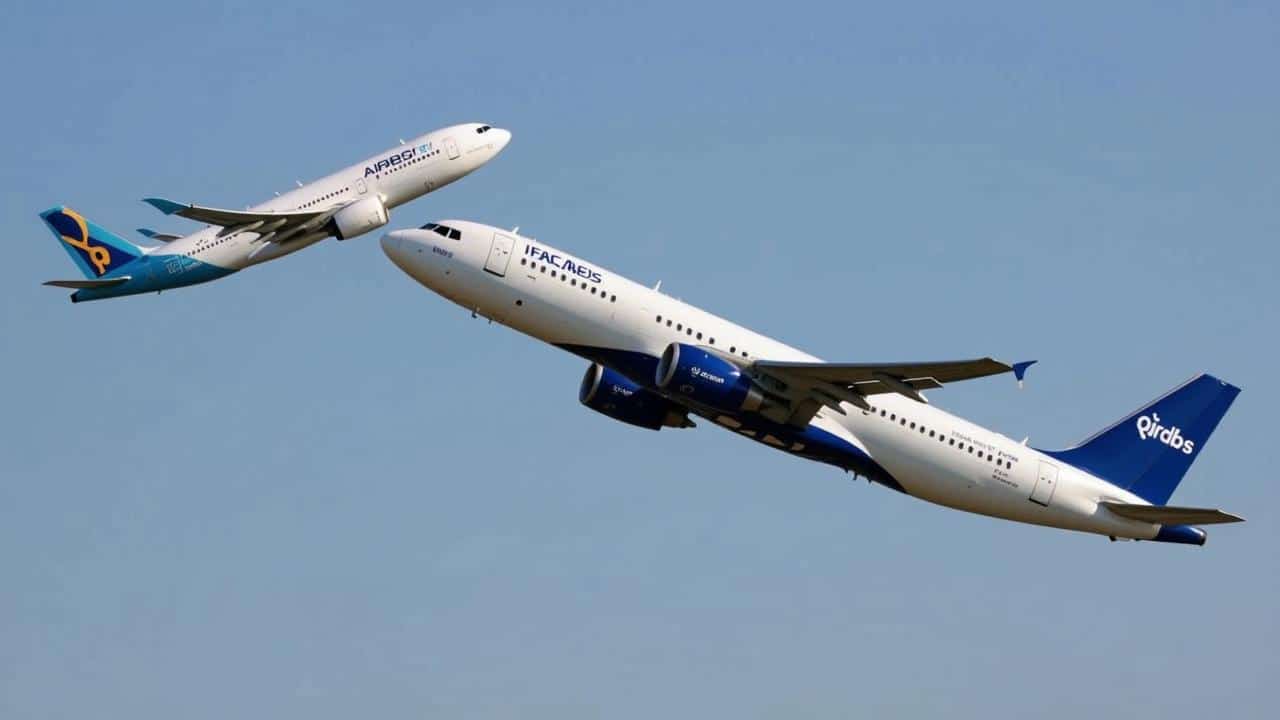
In a series of little-noticed test flights, Airbus and its partners rehearsed a manoeuvre that brings two long-haul jets to exactly the same point in the sky, at the same time, under standard air traffic rules – without the slightest reduction in safety margins.
A choreography in the sky that once seemed impossible
Between September and October 2025, Airbus organised eight demonstration flights over the North Atlantic as part of its fello’fly programme. The goal was both simple and bold: prove that two commercial aircraft can be guided to the same waypoint with metre-level precision, while still following conventional air traffic control procedures.
The exercise sounds abstract until you picture it. Two widebody jets, each on its own transatlantic route, each speaking to different controllers, must converge on an invisible rendezvous point in three dimensions, at a set time, while maintaining prescribed separation.
The trials confirm that highly precise in-flight “rendezvous” between airliners is technically and operationally feasible, opening the door to formation flight for fuel savings.
This is the first operational building block for a concept inspired by migrating birds. Just as geese take turns flying in V-formation to reduce the energy each bird expends, the idea is to let one aircraft benefit from the aerodynamic wake of another and trim its fuel burn.
Why waking up the wake could cut fuel use by 5%
The technical term behind the project is “wake energy retrieval”. Every large aircraft generates a complex pattern of rotating air behind its wingtips, known as wake vortices. Those swirling structures create regions of upward-moving air.
If a second aircraft positions itself carefully in that upwash, part of the air’s lift is “free”. That extra support lets the trailing jet reduce engine thrust while maintaining speed and altitude.
Airbus estimates that, once the full technique is in service, long-haul flights using wake energy retrieval could cut fuel consumption by around 5%. That might sound modest, but across a fleet it adds up to thousands of tonnes of kerosene each year and a corresponding reduction in CO₂ emissions for a sector that contributes about 1% of global CO₂.
- Target fuel saving per long-haul flight: ~5%
- Technology focus: precise rendezvous + formation positioning
- Main beneficiaries: airlines, passengers, climate
- Core constraint: no compromise on safety or separation rules
The key attraction for airlines is that these gains come without buying new airframes or engines. Instead, they rely on smarter operations, highly accurate navigation and new procedures jointly agreed with regulators and air traffic control.
➡️ Goodbye footprint marks on your sandals: the trick to erase them and make them look new again
➡️ Shifting: why this mental escape practice is increasingly popular with teenagers
➡️ Already the world’s top tyre maker, Michelin thinks bigger with €500m double US acquisition
➡️ Stop washing your hair this often dermatologist warns we have been doing it all wrong
➡️ How mental fatigue influences posture throughout the day
An ocean as a test range
A multinational cast on the North Atlantic tracks
The test campaign gathered an unusually broad cast. On the airline side, Air France, Delta Air Lines, French bee and Virgin Atlantic provided aircraft, crews and operational input. In the control centres, teams from AirNav Ireland, France’s DSNA, pan-European body EUROCONTROL and the UK’s NATS coordinated the moves.
Engineers often compare the manoeuvre to two cyclists trying to meet at the same bend of a mountain road while each follows instructions from a separate support car. Any tiny variation in wind, speed or route forces a recalculation.
For pilots, the new element in the cockpit was Airbus’s Pairing Assistance Tool (PAT). This software module runs continuous simulations of both aircraft’s trajectories and suggests tiny changes in speed or routing so that the rendezvous point and time line up perfectly.
The PAT acts like a hyper-precise GPS that doesn’t just tell you where the other aircraft is, but predicts exactly where it will be minutes ahead.
On the ground, controllers needed their own tools. Special interfaces let centres in Ireland, France, the UK and the EUROCONTROL network check proposed instructions against all existing safety and separation rules. Only when every level – cockpit, airline ops, ATC – agreed, could a step proceed.
A four-step protocol designed around safety margins
The flight tests validated a structured procedure that keeps a clear buffer between the two aircraft while they converge:
Throughout the sequence, vertical and horizontal separations stay inside current regulatory limits. The goal is not to bring jets uncomfortably close, but to show that trajectories can be aligned with enough precision to make later formation flight both predictable and manageable for ATC.
Borrowing from geese, with a lot more maths
For many passengers, the idea of “flying in the wake” of another aircraft sounds unsettling. In everyday aviation language, wake turbulence is something to avoid. So what changes with fello’fly?
The answer lies in control. In routine operations, controllers keep large gaps between aircraft precisely because wake vortices can be unpredictable and dangerous at close range. In the Airbus concept, the trailing plane does not sit directly in the strongest turbulence zone. Instead, it positions itself in the carefully modelled upwash regions around the vortex cores.
That positioning relies on advanced modelling, high-accuracy satellite navigation and constant cross-checks between the two aircraft and ground systems. While wild geese rely on instinct and visual cues, long-haul jets use algorithms, certified avionics and tightly scripted procedures.
The fello’fly trials also connect to the GEESE research project under Europe’s SESAR programme. GEESE brings together players such as Boeing, ENAC, Indra, the German aerospace centre DLR, and several air navigation service providers. The surprising alignment of arch-rivals in commercial aircraft shows how collaborative this type of innovation must be.
Still no commercial formation flights – yet
Crucially, none of the recent transatlantic tests involved actual wake energy use. The aircraft did not fly in close aerodynamic formation. The purpose was to prove, under real traffic conditions, that precise, safe rendezvous is achievable at scale.
Think of it as rehearsing the dance steps before adding the lift. Only when the industry and regulators are fully comfortable with the rendezvous phase will trials move to shorter separations where the trailing jet can genuinely harvest lift from the wake.
That second phase will require new certification work, human factors studies, and probably dedicated training for crews and controllers. Yet the potential reward – a reliable 5% cut in fuel burn on some of the world’s busiest long-haul corridors – explains why the idea is advancing.
How fello’fly fits into aviation’s climate toolbox
Fello’fly sits alongside a cluster of other initiatives aimed at shrinking aviation’s environmental footprint. None of them alone can decarbonise long-haul flight, but combined they can shift the trajectory.
| Approach | Main benefit | Timeframe |
|---|---|---|
| Sustainable aviation fuel (SAF) | Up to ~80% lifecycle CO₂ reduction versus fossil fuel, depending on feedstock and pathway | Scaling now, constrained by cost and supply |
| New-generation engines | Lower fuel burn through higher efficiency and new architectures | Ongoing, tied to new aircraft models |
| Aircraft weight reduction | Composite materials, lighter cabins, more efficient systems | Incremental, across fleet updates |
| Electric / hybrid aircraft | Low- or zero-emission regional and urban flights | Emerging, focused on short range |
| Hydrogen concepts | Potential for near-zero CO₂ at the tailpipe | Long-term, beyond 2035 for large jets |
| Wake energy retrieval | Operational fuel savings on existing long-haul routes | Medium term, once certified |
The attraction of concepts like fello’fly is that they target today’s long-haul workhorses – widebody aircraft that will keep flying for decades. While radical new designs mature, smarter use of the current fleet can bridge part of the gap.
Risks, questions and what passengers might notice
The main risks do not lie in the physics, which are fairly well understood, but in execution. Controllers must manage more coupled trajectories in already busy skies. Crews have to handle a new layer of procedures, automation modes and cross-communication between aircraft. Regulators will want robust evidence that added complexity does not erode safety culture.
From a passenger’s perspective, the change could be almost invisible. Cabin announcements are unlikely to mention that the aircraft is converging with a partner flight halfway across the ocean. The only subtle clue might be a slightly different pattern of small heading or speed changes en route, automatically commanded to maintain the rendezvous profile.
One practical concern is contingency management. If one aircraft suffers a technical issue, hits unexpected turbulence or receives a rerouting, the formation plan must dissolve gracefully. That means every phase includes clear “off-ramps” that return each flight to fully independent operation with standard separation.
Key terms and scenarios behind the concept
Several technical notions sit at the heart of Airbus’s project:
- Wake vortex: rotating tubes of air shed from wingtips that trail behind an aircraft and can affect those following.
- Upwash: the upward flow around the vortex that, correctly used, provides extra lift to a trailing wing.
- Separation minima: regulated minimum distances and altitudes between aircraft, designed to keep wake effects and collision risk under control.
- Formation flight: coordinated operation of two or more aircraft keeping a defined relative position.
Engineers are already sketching scenarios where multiple airline pairs use fello’fly on crowded transatlantic routes. For example, overnight flights from Paris and Amsterdam to New York could be twinned with counterparts from London or Frankfurt, forming short-lived “pairs” over the ocean before peeling off towards their final destinations.
In another scenario, alliances might coordinate departure slots so that one carrier’s aircraft routinely plays the lead role, with a partner’s jet acting as the follower and collecting most of the fuel benefit. Commercial models will need to decide how such savings are shared.
As those questions play out, the 2025 North Atlantic trials mark a clear line in the sand: orchestrated aerial rendezvous between large commercial jets is no longer a PowerPoint concept, but a tested procedure that regulators and airlines must now judge on its wider implications.