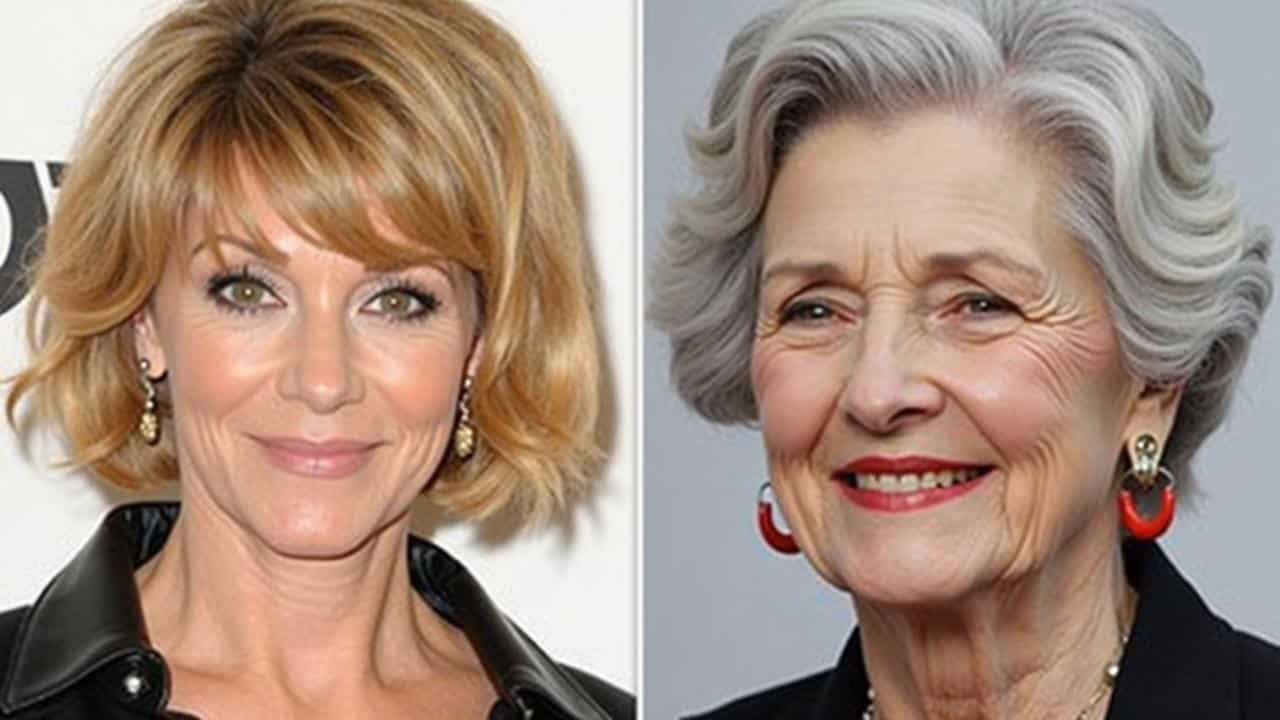
The salon smelled faintly of hairspray and coffee when she walked in. Seventy-two, a neat beige coat on her shoulders, and that very familiar haircut: short, tightly curled, sprayed into place like a helmet. Her granddaughter had booked the appointment, whispering at the desk, “Please, she wants something modern. She’s terrified of looking like… a grandma.”
The hairdresser smiled, used to this quiet panic that arrives with a certain number of candles on the cake. He lifted a strand, stepped back, and sighed. The cut was clean, but everything about it pulled the face down.
One tiny choice was adding ten years in the mirror.
The “grandma” hair effect that nobody asks for
He calls it “the shrinking head effect”. Short at the back, tight around the ears, lots of little curls frozen in place. From behind, the head seems smaller. From the front, the features look harder, almost pinched.
On a teenager, it would just look quirky. After 70, it suddenly turns into a label. The famous “grandma” hair, the one that people spot before they even see your eyes.
The worst part is that most women didn’t choose it out of love. They chose it out of habit, or convenience.
Ask any experienced stylist and they’ll tell you the same story. A woman around 65 cuts her hair shorter “just for now, to make things easier”. Then the years go by, the cut gets shorter, the curls tighter, the color lighter.
At 75, everything is practical. Wash, set, spray. The hair hardly moves. It no longer frames the face, doesn’t catch the light, doesn’t tell a story.
One Paris hairdresser I spoke to calls it “the retirement of hair”, that moment when style is replaced by routine, and nobody dares question it.
From a technical point of view, this classic helmet cut concentrates the volume on the top and removes it from the sides. The temples are exposed, the nape is too clean, and the hair is lifted away from the face instead of softening it.
➡️ How mental fatigue influences posture throughout the day
➡️ This tiny conversational habit can quietly improve relationships
➡️ Already the world’s top tyre maker, Michelin thinks bigger with €500m double US acquisition
➡️ Shifting: why this mental escape practice is increasingly popular with teenagers
➡️ Scientific breakthroughs in diabetes in mark a historic turning point in treatment
➡️ Psychology explains what it really means when someone always interrupts others
Result: the features seem sharper, the jawline appears more saggy, and every small line is highlighted. Light doesn’t slide along the hair anymore, it stops in a solid mass.
*That’s the real secret: it’s not the length that ages you, it’s where the volume sits and how the hair moves around your face.*
How to escape the “helmet” and keep your face looking fresh
The hairdresser in the beige-coat story didn’t start by grabbing the scissors. He started by sitting down opposite her. “What annoys you most when you look in the mirror?” he asked. She hesitated, then answered quietly: “My face looks tired. Rounder. Sad.”
So he targeted exactly that. He suggested keeping it short, but not tight. Leaving softness around the ears. A bit of airy fringe, not a wall. Light layers that allowed the hair to move when she turned her head.
The idea wasn’t to look 40 again. It was to let her features breathe.
Let’s be honest: nobody really does this every single day. Very few women over 70 want to spend half an hour blow-drying. The trick is to ask for a cut that falls into place more or less on its own. Medium-short, yes. But with movement.
The big mistake is the “perfect weekly set” that turns your head into a static object from Monday to Sunday. The more solid and rigid the hairstyle, the more it contrasts with the small natural changes of the face.
Hair that swings a little, that separates, that lets a few pieces fall on the forehead, instantly brings softness. Even with white hair. Especially with white hair.
“The hairstyle that ages the most after 70 is the one that doesn’t move,” explains Marc, a salon owner who has been cutting hair for 30 years. “When everything is fixed, the eye only sees the wrinkles and the drooping. A bit of mess, a bit of texture, that’s what makes the face look alive.”
- Ask for softness at the temples, not a harsh, clean line
- Favor light layers over ultra-tight curls or rollers
- Keep some volume at the sides, not only on the top of the head
- Use a flexible styling cream instead of hard hairspray
- Consider a light fringe or side-swept strands to soften the forehead
Choosing a hairstyle after 70 that tells your story, not your age
Standing up from the chair, the woman in the beige coat barely touched her new hair at first. It was still short. Still easy to live with. But the contours of her face seemed calmer. The jawline a bit clearer. Her eyes, suddenly brighter.
She smiled, then frowned: “Why didn’t anyone suggest this to me earlier?” The hairdresser shrugged. Habit is a powerful thing. And the quiet fear of “trying too hard” often stops women from asking for more.
This is the subtle trap of the “grandma” haircut. It’s not just a style, it’s a message. “I’m done experimenting.” “I have to be reasonable.” “At my age, I can’t…” Those little sentences plant themselves in the mirror, day after day.
Yet the women who get the most compliments are often those who dare to keep a bit of personality in their hair. A lock a bit longer, a playful fringe, a natural texture finally embraced. Hair that doesn’t apologize. Hair that still says: I’m here.
Next time you sit in the salon chair, you can simply ask one question: “Which part of my current cut makes my face look more tired?” A good stylist will point to the too-clean nape, the hair glued to the head, the over-bleached color, or that helmet volume.
From there, the door opens. A few centimeters longer, a softer line around the neck, a less uniform white, a more natural movement. Tiny shifts, big visual change.
The real opposite of “grandma hair” isn’t long hair or drastic transformation. It’s a cut that respects your age while refusing to reduce you to it.
| Key point | Detail | Value for the reader |
|---|---|---|
| Avoid the “helmet” effect | No ultra-tight curls, rigid sets, or volume only on top | Prevents the face from looking harder and more tired |
| Keep movement and softness | Light layers, a bit of fringe, flexible products | Softens features and gives a fresher, more dynamic look |
| Talk honestly with your hairdresser | Describe what bothers you (jawline, eyes, tired look) | Leads to a tailored cut that supports your real needs |
FAQ:
- Does long hair always age you after 70?
No. What ages is heavy, flat hair with no shape. Long hair that’s lightly layered, maybe tied in a soft low ponytail or loose bun, can look very chic and modern at 70+.- Should I absolutely cut my hair short when I go grey?
Not at all. Many women keep medium or even long grey hair. The key is healthy ends, some structure, and a shape that frames the face instead of pulling everything back.- What hair color is most flattering after 70?
Usually, slightly softer tones than your original color. Very dark blocks can harden features, while creamy whites, soft greys, or gentle highlights brighten the complexion.- How often should I change my haircut as I age?
You don’t need a revolution every year, but revisiting your cut every 2–3 years with fresh photos or ideas helps avoid getting stuck in the “grandma” zone without noticing.- My hair is very fine and thinning. Can I still avoid the helmet effect?
Yes. Ask for a cut that keeps some length on top and at the sides, with minimal thinning. Use light volumizing products, not stiff spray, so the hair stays airy instead of hard and stuck.