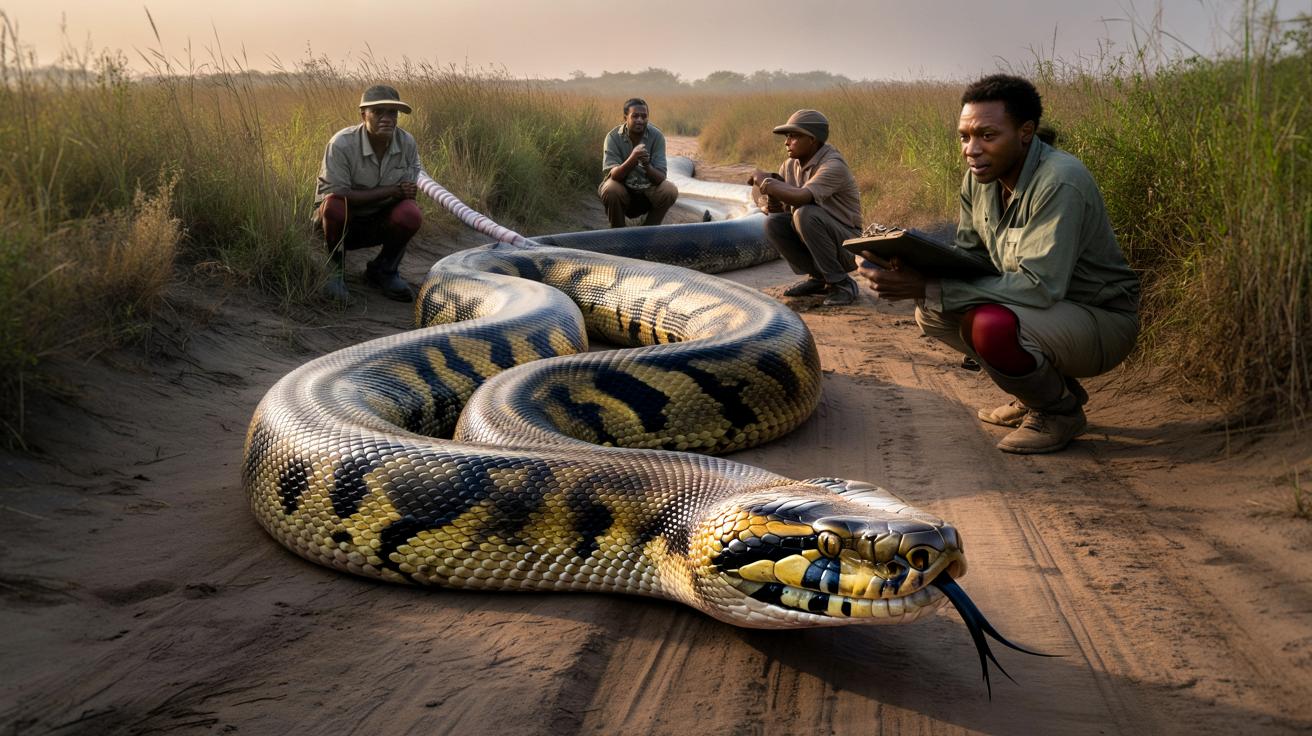
The grass parted with a sound like tearing paper, and then the ground itself seemed to move. One of the researchers froze, half step in the air, as a thick, dappled body slid across the game trail and kept going, and going, and going. Morning light caught on smooth, dark scales. A low whistle broke the silence, followed by someone muttering, “That can’t be right.”
Binoculars came up, measuring tapes came out, voices dropped.
Minutes later, that same quiet trail in a remote corner of southern Africa had turned into the kind of scene you usually only see on viral wildlife clips. Cameras clicked, GPS units beeped, scientists argued softly over centimeters.
They had just confirmed an African rock python so large that even the herpetologists were shaking their heads.
And the snake didn’t seem to care at all.
An African python so big it forced the experts to recheck their numbers
The official record came from a certified field expedition, not a fuzzy phone photo or a fisherman’s tale. A mixed team of local trackers and international herpetologists had been surveying a mosaic of wetlands and savanna when they stumbled on the massive female python coiled near a shaded burrow. She wasn’t stretched out dramatically for the cameras. She was just… there. Immense, quiet, heavy as the landscape itself.
What turned the moment from “big snake” into “scientific event” was the gear. Laser rangefinders, calibrated tape, standardized body-girth measures. Cold data, collected under strict protocols, with independent observers signing off on every figure.
Back at the temporary field lab, under a buzzing strip of solar-powered light, the numbers were laid out. Length beyond what most textbooks still cite for the species. Girth that implied a weight normally reserved for crocodiles, not snakes. The team ran the calculations twice, then a third time. Someone joked that the spreadsheet must be broken.
Yet the measurements held. The data set, complete with GPS coordinates, temperature readings, and photographic scaling, went straight into shared databases. No anonymous bragging on social media, no blurry “look how huge!” posts. This time, the world’s largest African rock python claim came stamped with scientific signatures and institutional seals.
For the scientific community, this confirmation lands in the middle of a long-running debate. Were the legendary giant pythons of African villages exaggerated memories, or hints of an upper size limit we rarely get to document? With this specimen, many researchers are starting to accept that **our mental image of the species may have been too small**.
➡️ Approaching dogs reflects openness to uncertainty
➡️ Psychology explains what it really means when someone always interrupts others
➡️ Shifting: why this mental escape practice is increasingly popular with teenagers
➡️ Stop washing your hair this often dermatologist warns we have been doing it all wrong
➡️ Scientific breakthroughs in diabetes in mark a historic turning point in treatment
➡️ This slow-roasted pork shoulder makes the juiciest sandwiches you’ll ever eat
➡️ How mental fatigue influences posture throughout the day
The python’s size also raises harder questions. To reach that kind of bulk, an animal needs time, habitat, and enough big prey to fuel steady growth. That means pockets of ecosystem health still exist where we didn’t fully expect them. It also means they’re fragile. One road, one new farm, one wave of hunting pressure, and giants like this simply vanish from the record.
How you measure a giant snake when your hands are shaking
There’s a surprisingly practical side to all this: measuring a snake that big without stressing it or getting hurt. The team used a method that’s become standard in serious herpetology work. First, they watched the python from a distance, waiting for her to settle and show steady breathing. Only then did they approach, slow and low, in a semi-circle, allowing an escape route.
Once close enough, they used a flexible, marked rope as a first “soft” measure, laying it gently along her length as she rested. The rope was then stretched along a tape to translate the curves into a reliable total length. No tugging, no dragging, no dramatic wrestling for the camera.
If you’ve ever seen viral clips of people manhandling big snakes for a photo, you probably felt a knot in your stomach. The expedition team did, too. Restraint was used only briefly and only when the python’s safety required it. Her head was gently guided, body supported by multiple hands, with constant checks for signs of stress: rapid tongue flicks, sudden muscle tension, attempts to bolt.
Let’s be honest: nobody really does this every single day. Even pros feel their pulse spike when they’re inches away from a muscular jaw lined with backwards-curving teeth. That’s why clear roles mattered. One person watched the head, one called out measurements, one handled the data, and one kept track of the exit route in case things went sideways.
The team members describe the moment with a mix of awe and humility.
“Up close, the word ‘monster’ disappears,” one herpetologist told me later. “You’re holding years of survival in your hands. Every scar, every thickened muscle, it all says: I made it through droughts, fires, and people with machetes.”
Alongside the quote, several practical lessons quietly emerged from the field notes:
- Always approach large snakes with a clear escape path for the animal.
- Use soft, flexible tools first, and hard numbers second.
- Limit handling time to the absolute minimum.
- Document with photos and scale objects, not just raw measurements.
- Center the animal’s welfare, not the selfie.
A giant snake that says more about us than about her
This python will never read the headlines about her. She’ll slide back into the reeds, ambush a warthog or two, maybe disappear into a burrow for days. The frenzy is ours: the press releases, the debates, the “biggest ever?” arguments that light up forums and feeds. Yet behind the spectacle sits a quieter, uncomfortable reality. Every confirmed giant like this tends to be surrounded by shrinking maps of suitable habitat.
We’ve all been there, that moment when a piece of news makes you feel both excited and slightly guilty at the same time. You marvel at the record, then remember the roads, the fences, the poisoned rats that ripple up the food chain. *A snake that grows this large is a luxury of a functioning ecosystem.* Take away just a few pieces, and those stories of enormous pythons sink back into rumor.
| Key point | Detail | Value for the reader |
|---|---|---|
| Verified giant python | Measured by certified herpetologists using standardized methods | Separates myth from reality with trusted data |
| Field techniques | Low-stress measurement, careful handling, team roles | Shows how real science works behind viral wildlife stories |
| Conservation signal | Such size implies intact habitat and big-prey availability | Helps readers connect record-breaking animals to ecosystem health |
FAQ:
- Question 1How big was this African python compared to “normal” ones?
Most African rock pythons people see are several meters long, already impressive. This confirmed individual pushed into the extreme upper range documented for the species, both in length and girth, placing her among the largest scientifically measured African pythons on record.- Question 2Could this snake be a new species or subspecies?
Based on current information, no. The scale patterns, head shape, and location fit the known African rock python profile. The excitement comes from her exceptional size, not from any obvious sign that she belongs to a different taxonomic group.- Question 3Are African rock pythons dangerous to people?
They’re powerful predators that demand respect, especially at this size, and there have been rare serious incidents. That said, they usually avoid humans when they can. Most conflicts happen when people corner, handle, or try to kill them, or when habitat loss forces snakes closer to villages and livestock.- Question 4What do scientists learn from one giant snake?
More than you’d think. Body size hints at prey availability, hunting success, and years of survival. Tissue samples can reveal diet, pollution exposure, and genetics. Even the scars on the body tell stories of past encounters with prey, predators, and people.- Question 5Will this record ever be broken?
Very likely. Somewhere in a quiet stretch of wetland or woodland, another python is hunting, growing, and staying just out of sight. As survey methods improve and protected areas stabilize, the next headline-making giant is probably already alive, simply not yet measured or photographed.