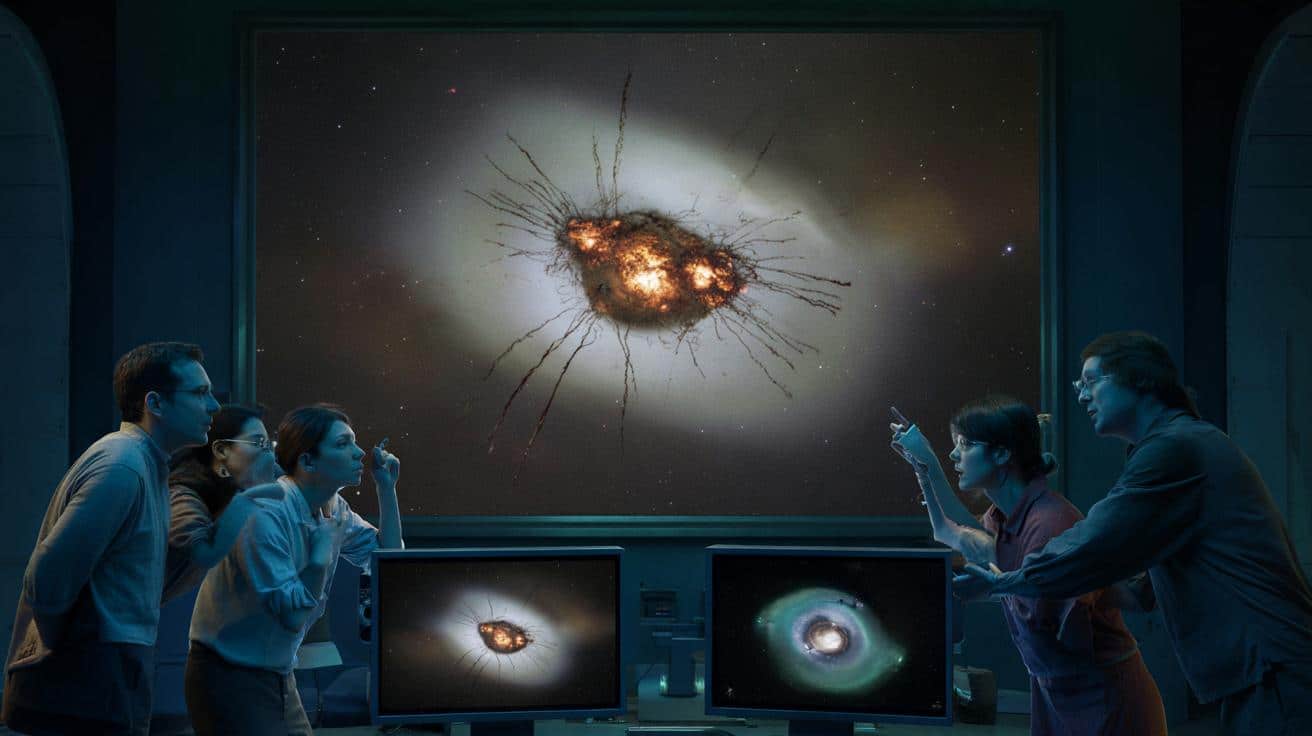
On the screen in front of them, the comet looks like a ghost with a spotlight on it. A glowing, shredded core, a tail curling and twisting, jets spraying like frozen fireworks. It’s 3I ATLAS, only the third interstellar comet ever spotted, and tonight a small control room of tired astronomers is arguing in low, tense voices.
They’re not disagreeing about whether the images are beautiful. They’re disagreeing about what they actually mean.
Outside, the night is clear and quiet. Inside, every new frame of data lands like a tiny bomb.
One researcher whispers, “If this is real, the textbooks are wrong.”
The room falls silent for a second, as if everyone feels the floor tilt beneath them.
Why these new images of 3I ATLAS are shaking up the experts
The latest images of interstellar comet 3I ATLAS arrived almost like a leak from another universe. Ultra-sharp views from ground-based telescopes, stacked exposures from amateur observatories, and a few early shots from space-based cameras suddenly began circulating in private Slack channels and late-night email threads.
What they show is not a neat, icy snowball drifting politely through our Solar System.
They show something torn, stretched, strangely active, with jets of gas that seem to flicker on and off in ways nobody expected.
The first wave of surprise came from a European team that stitched together dozens of long-exposure shots into a single composite. In their processed image, 3I ATLAS doesn’t look like a point with a tail. It looks like a splintered ember, surrounded by a faint, lopsided halo, as if the comet had been half pulled apart.
Within hours, American and Japanese groups shared their own versions. Some showed signs of multiple fragments. Others hinted at a corkscrew-shaped tail, twisting as if some hidden force was shaping it.
On social media, the word “impossible” appeared more than once.
Astronomers are now split into camps. One side argues that these details expose brand‑new physics of how interstellar comets react when they hit sunlight for the first time in millions of years. Another insists the drama is mostly an illusion: imaging artifacts, aggressive contrast stretching, algorithms filling in gaps with patterns that aren’t really there.
This clash isn’t just academic. **If the structure in these images is real, it rewrites how we think objects survive the brutal journey between stars.**
And if it’s not, it exposes how vulnerable modern astronomy is to its own tools.
What the images might really show – and why no one agrees
To understand the fight, you need to picture what astronomers are actually doing. They’re chasing a dim speck racing through space at tens of kilometers per second, trying to collect photons that left the comet minutes ago and then combing those photons through software like detectives with magnifying glasses.
One group smooths the noise, another boosts the contrast, a third subtracts the background stars pixel by pixel.
Out the other side come “spectacular” images that look almost too cinematic to be real.
One example keeps coming up in conference calls. A Chilean observatory team produced a shot where 3I ATLAS appears to have not one, but at least three bright knots along its core. To some, this screams “fragmentation”: the comet is breaking up as it feels the Sun’s heat and gravity for the first time.
Others say those knots line up a little too perfectly with known background stars that were algorithmically removed. They argue that the software may have “over-corrected”, leaving ghostly clumps that look like pieces of comet.
We’ve all been there, that moment when a photo filter turns an ordinary picture into something dramatic enough to feel fake.
Behind the scenes, there’s a more uncomfortable debate. A few senior researchers are quietly warning that the race for eye‑catching visuals – the sort that go viral on X, Instagram, and yes, Google Discover – is creeping into scientific practice.
They worry that teams may be unconsciously “massaging” their images to highlight possible jets, spirals, or mini-fragments because those details sound like headlines. *Raw science rarely trends; enhanced science does.*
At the same time, younger astronomers push back, arguing that new processing techniques are precisely how we’ve uncovered unexpected phenomena in the past, from exoplanet atmospheres to faint galaxy streams.
How to read these comet images like a pro (without a PhD)
There’s a simple gesture that changes everything: before you share that mind‑blowing comet photo, ask yourself how many invisible steps sit between “what the telescope saw” and “what I see on my phone.”
Astronomers call the earliest version the “raw frame” – often grainy, streaked, and full of cosmic rays and satellite trails. From there, each processing decision nudges the image toward clarity or confusion.
If you look for three things – contrast, color, and context – you can usually tell whether you’re seeing physics or Photoshop‑adjacent enthusiasm.
Start with contrast. Over‑boosted contrast can turn gentle gradients of dust into sharp edges that look like cracks or jets. Next, look at the color palette. Many space images use “false color” to highlight different wavelengths; beautiful, yes, but often not what human eyes would see.
Finally, check the context: Is the image credited to a research team? Is there a link to a paper, a preprint, or at least a technical note explaining the filters and exposure times?
Let’s be honest: nobody really reads all the methods sections, every single day. But pausing to peek at the caption already puts you ahead of most scrollers.
➡️ Airbus achieves historic feat by bringing two planes to the same point without collision
➡️ How mental fatigue influences posture throughout the day
➡️ This tiny conversational habit can quietly improve relationships
➡️ Shifting: why this mental escape practice is increasingly popular with teenagers
➡️ Approaching dogs reflects openness to uncertainty
One senior astronomer I spoke to summed it up in a single sentence:
“Every space image is a negotiation between reality and the tools we use to look at it.”
She keeps a short checklist taped to her monitor whenever a “sensational” comet or asteroid picture lands in her inbox:
- Who processed this image, and for what audience?
- How many exposures were stacked or combined?
- Were background stars or galaxies removed digitally?
- Do multiple teams, with different methods, see the same structure?
- Is anyone willing to say, on record, what they’re still not sure about?
Look at 3I ATLAS through that lens and the controversy stops feeling like drama and starts feeling like the normal, messy heartbeat of science.
What this cosmic argument really says about us
The fight over 3I ATLAS isn’t only about a lonely chunk of ice and rock from another star. It’s about how we handle uncertainty in a world that loves confident headlines. A blurry, ambiguous comet doesn’t travel nearly as far online as a “shredded alien visitor defying physics.”
Astronomers are human. They feel that current pulling at them, whether they admit it or not.
And the rest of us, scrolling past, help decide which version of the story wins.
These new images are a mirror. On one side, we see our hunger: for wonder, for beauty, for the feeling that the universe still has surprises. On the other, we see our impatience: our low tolerance for “we don’t know yet,” our rush to frame every anomaly as a revelation.
When experts clash over what 3I ATLAS really reveals, they’re also wrestling with how fast to speak, how bold to be, how cautious they can afford to sound in a noisy public square.
Some will remember 3I ATLAS as the comet that challenged our models of how interstellar objects hold together. Others will remember it as a lesson in humility about images, algorithms, and the subtle line between signal and story.
What lingers, long after the comet has vanished back into the dark, is a quieter question: the next time something from another star shows up at our doorstep, will we be ready to look at it slowly enough to really see?
| Key point | Detail | Value for the reader |
|---|---|---|
| How 3I ATLAS looks | New images show a distorted, possibly fragmented comet with unusual jets and tail structure | Helps you visualize why astronomers are so excited – and divided |
| Why experts disagree | Some see genuine new physics, others see processing artifacts and over‑interpreted data | Gives you a clear lens on scientific debate instead of just the hype |
| How to read space images | Simple checks on contrast, color, and context reveal what’s likely real vs. exaggerated | Lets you judge future “spectacular” space photos with more confidence |
FAQ:
- Is 3I ATLAS really an interstellar comet?Yes. Its trajectory is hyperbolic, meaning it’s moving too fast to be bound to the Sun’s gravity and is just passing through from outside our Solar System.
- Why are these new images so controversial?They seem to show complex structures – fragments, jets, possible twists in the tail – that some teams believe are real features and others suspect are artifacts from image processing.
- Could 3I ATLAS be an alien object like ‘Oumuamua was rumored to be?Current data fits a natural comet made of ice and dust. No evidence points to artificial origin, even if the images look dramatic.
- Are the public images the same as what scientists use in papers?Not always. Scientists often work with less processed, more quantitative versions, while public releases are cleaned up, color‑mapped, and composed for clarity and impact.
- What happens to 3I ATLAS next?It will swing through the inner Solar System, gradually fade as it moves away, and eventually return to deep interstellar space, leaving behind only the data – and the arguments – we’ve gathered while it was here.