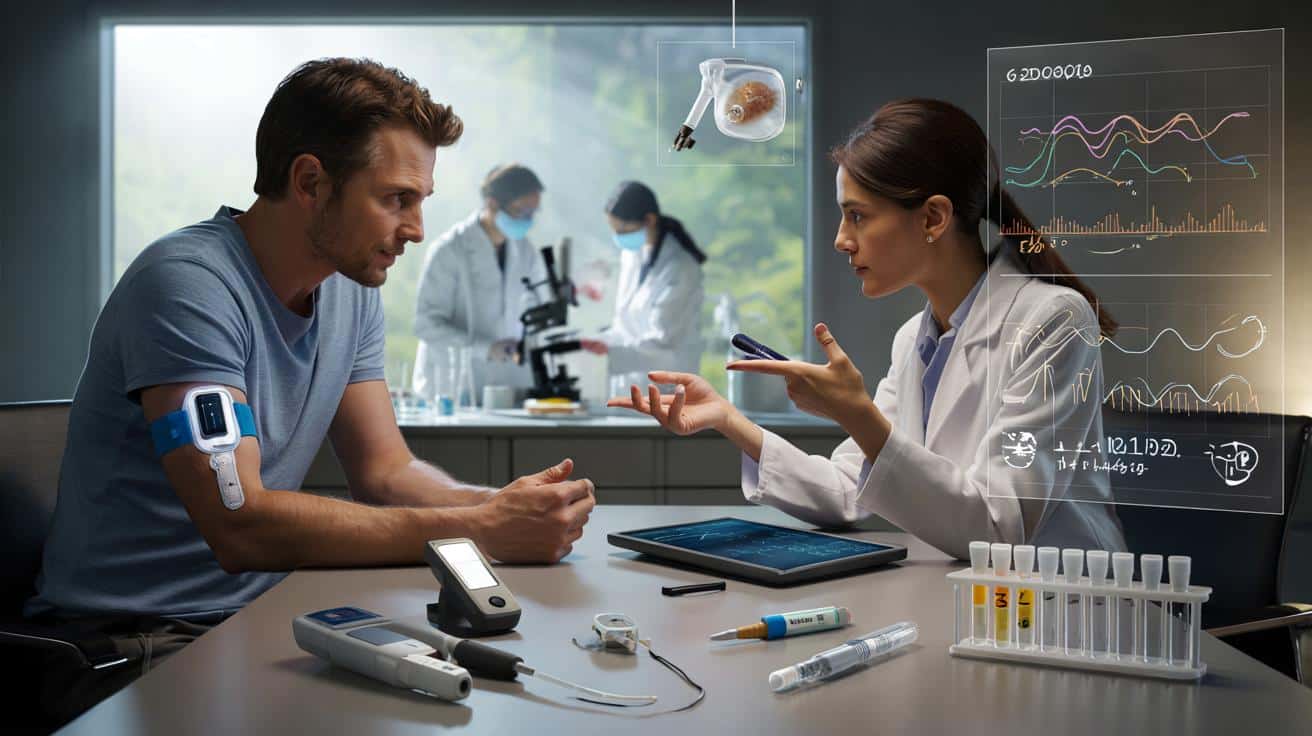
The nurse laid the continuous glucose monitor on the table like it was a new phone, not a medical device. Across from her, a 32-year-old software engineer with type 1 diabetes watched, half skeptical, half hungry for hope. He’d been pricking his fingers since he was eight. He knew the smell of alcohol swabs better than the smell of coffee.
On the screen, his blood sugar curve from the past week appeared in color, dancing up and down like a restless heartbeat. Then she swiped to a new page: a projected curve for the next three hours, powered by AI.
He blinked. “You mean… it predicts what will happen before it happens?”
She nodded. That was the moment you could feel the ground quietly shifting under what we call “chronic disease.”
From survival to real freedom: diabetes care flips a switch
For decades, diabetes treatment has been about survival. Stay alive, avoid the worst complications, count the carbs, take the shot. Repeat tomorrow.
Now, quietly, **something very different is emerging**. We’re sliding from a world of rescue into a world of real-time coaching, automation, and, more and more, biological repair.
Walk into a modern diabetes clinic and you’ll see it. Hybrid closed-loop insulin pumps that talk to sensors. Smart pens that log every dose without you doing anything. Apps that vibrate your phone before your sugar even crashes.
You can almost feel the old rulebook getting dusty.
Consider GLP-1 drugs like semaglutide and tirzepatide, first known for type 2 diabetes and now splashed across headlines for weight loss. For many people with type 2, they don’t just lower sugar. They curb appetite, change food cravings, and in some cases trigger double-digit weight loss.
A 55-year-old bus driver in Madrid described it like this: “For the first time in 20 years, food is not shouting at me all day.” He didn’t switch diets. He didn’t suddenly become more disciplined. His biology shifted.
➡️ This tiny conversational habit can quietly improve relationships
➡️ How mental fatigue influences posture throughout the day
➡️ People who find love easily share these 2 key traits
➡️ Psychology explains what it really means when someone always interrupts others
➡️ Airbus achieves historic feat by bringing two planes to the same point without collision
➡️ Stop washing your hair this often dermatologist warns we have been doing it all wrong
➡️ The budgeting concept that finally clicked after years of frustration
Large trials show these drugs can reduce cardiovascular risk, help protect kidneys, and in some cases send type 2 diabetes into remission when combined with lifestyle changes. That word—remission—used to be whispered. Now it’s on conference slides in huge letters.
Underneath these changes is a simple reality: diabetes is no longer just “high sugar.” It’s a complex metabolic storm involving hormones, the immune system, fat cells, gut bacteria, and even the brain.
The breakthroughs that matter most today are the ones that respect that complexity. Lab-grown beta cells that can sense sugar and release insulin like the pancreas once did. Gene-editing techniques aimed at calming the immune attack in type 1. Tiny implantable devices wrapped in protective “shields” so the body doesn’t reject them.
The goal is shifting from endless correction to restoring balance. That’s more than a technological upgrade. It’s a historic change in how we imagine the endgame of diabetes.
AI, implants, and daily life: what changes in practice
The most visible shift for many people starts on the phone screen. AI-driven diabetes apps now digest streams of glucose data, insulin doses, meals, and steps, and then quietly send small nudges. “You’ve been trending upward after breakfast the past three days. Consider a 10-minute walk right after eating.”
It doesn’t sound spectacular. Yet those tiny adjustments, multiplied over months, flatten brutal sugar swings that used to mean headaches, mood crashes, and nights spent staring at the ceiling.
Behind the scenes, **new “smart” algorithms** in insulin pumps predict where glucose will be 30 minutes from now and adjust delivery in advance. That’s a leap from reacting to preventing. It’s the difference between slamming the brakes and having cruise control that sees the hill before you do.
On the more futuristic side, cell therapy is finally moving out of sci-fi territory. In trials, some people with long-standing type 1 diabetes received lab-grown insulin-producing cells derived from stem cells. Within months, a portion of them drastically reduced their insulin needs. A few stopped injections completely for a time.
There are catches: immune-suppressing drugs, surgical procedures, costs that don’t feel real yet. Still, for families who have lived around alarms and carb counting for years, the idea that a pouch of cells under the skin could take over part of the work feels almost unreal.
We’ve all been there, that moment when a medical promise sounds too good to trust. Yet the lab graphs are starting to match the hopeful headlines.
Behind all the optimism, there’s a plain-truth sentence nobody in a white coat will dispute: *Diabetes is still exhausting*. The best tech means nothing if it gathers dust in a drawer or becomes one more thing to charge every night.
That’s why some of the most interesting “breakthroughs” right now are about psychological load. Devices with fewer alarms. Interfaces that don’t shame you with red numbers. Programs that pair new treatments with coaching, mental health support, and realistic expectations.
The science of glucose is finally meeting the science of human behavior. When a treatment respects both, people tend to stick with it. That’s where the real magic happens—far away from conference stages, in kitchens and workplaces and late-night fridges.
Living through the turning point: what helps, what hurts
One practical shift many endocrinologists quietly suggest now: think in trends, not in single numbers. Instead of obsessing over every reading, watch how your 24-hour “glucose story” evolves.
Continuous glucose monitoring helps with this. A quick glance at the curve tells you if you’re rising, falling, or cruising. The trick is to use that information like a friendly scoreboard, not a permanent judgment.
A small method that changes a lot: pick one daily “anchor moment” to check your curve deeply—after breakfast, before bed, during your commute home. Not ten times a day. One. Give your brain a predictable window for decisions and leave the rest of the day to living.
Many people fall into the same trap with new drugs or devices: expecting a total reset from day one. When that doesn’t happen, frustration hits hard, and the upgraded tech becomes a symbol of failure rather than support.
The more honest clinicians now warn patients upfront. You’ll still have off days. You’ll still misjudge a meal. You might still eat that late pizza and wake up higher than you wanted. These tools are scaffolding, not a miracle cure.
Let’s be honest: nobody really does this every single day exactly “by the book.” The people who do best aren’t perfect; they simply recover faster from the messy days and use the tools to shorten the rough patches.
“People imagine the big breakthrough as a single pill or a single device,” says Dr. Leila Cohen, a diabetologist involved in several international trials. “What we’re seeing instead is a convergence: smarter drugs, smarter tech, and a deeper respect for the human side of this disease. Put together, that’s a turning point.”
- Use tech as a helper, not a judge
Treat glucose graphs and pump data as information, not a moral score. Notice patterns, don’t label yourself. - Start with one change at a time
New GLP-1? Hybrid pump? Mental load climbs fast. Give each change a few weeks before stacking another. - Protect your emotional bandwidth
Short therapy, a peer group, or even a trusted friend who “gets it” can be as crucial as the newest gadget. - Ask about what’s coming next
Many clinics now run early-access programs or registries. Simply asking, “What’s on the horizon that might fit me?” opens doors.
What this moment really means for the future of diabetes
For someone newly diagnosed today, the word “diabetes” doesn’t have to mean exactly what it meant ten or twenty years ago. The story used to be written almost in stone: progressive, relentless, a slow tightening of rules and restrictions.
Now the storyline is less fixed. Some people with type 2 are coming off medications after weight-loss injections and lifestyle shifts. Children with type 1 are growing up with pump systems that automatically smooth much of the danger overnight. Early-stage research hints at vaccines and cell implants that could one day protect or rebuild the pancreas.
None of this erases the tough days. There will still be sensors that fail, insurance battles, drugs that don’t work for everyone. There will still be people left out by cost or geography. Yet there is something new in the air: a sense that the ceiling is lifting.
This is what a historic turning point often looks like from the inside. Not a single dramatic headline, but a slow change in daily routines, in conversations at the pharmacy counter, in the questions patients dare to ask: “Could I need less insulin one day?” “Could my child grow up with fewer scars from this?”
The science won’t answer all of those questions tomorrow. Still, the fact that they are reasonable questions now—that alone marks a shift worth paying attention to, and worth talking about at the next family dinner, support group meeting, or quiet late-night scroll through health news on your phone.
| Key point | Detail | Value for the reader |
|---|---|---|
| New generation drugs (GLP-1, dual agonists) | Lower glucose, reduce weight, and can improve heart and kidney outcomes in type 2 diabetes | Opens the door to remission for some people and less daily struggle around food |
| Smart tech and AI-assisted management | Continuous monitors, hybrid closed-loop pumps, and apps that predict trends instead of just reacting | Fewer dangerous highs and lows, more mental space, and a more “normal” daily life |
| Emerging cell and gene therapies | Stem-cell–derived beta cells, immune-modulating approaches, and protective implants | Not yet widely available, but signals a future where insulin dependency and complications could dramatically shrink |
FAQ:
- Question 1Are GLP-1 drugs or new weight-loss injections a cure for type 2 diabetes?
- Question 2Can people with type 1 diabetes really stop insulin after cell therapy?
- Question 3Is AI-based diabetes tech safe and reliable for everyday use?
- Question 4What can I ask my doctor if I want access to newer treatments?
- Question 5Will these breakthroughs be available and affordable for everyone?